Kill Brother, Kill Sister: Episode One
Now a Podcast: Episode One – A Bomb, A Murder: Setting the Scene
Also on Apple Podcasts: Episode One – A Bomb, A Murder: Setting the Scene
My latest work, Kill Brother, Kill Sister, is a true-crime book that has been too long in the making. The idea for a book documenting a murder — that soon became two murders — first hit in 1991, at the time Butcher, Baker was first published. It wasn’t called Kill Brother, Kill Sister then. It didn’t have a name. Those things usually come later. Did I wait or did I procrastinate? Hard to say. But in the intervening years a treasure trove of documents from the South Pacific made their way into U.S. government repositories. That was what I was waiting for (even if I didn’t know it). Suddenly I had more than a book. I had a book. Here’s what a recent review has to say. I couldn’t say it better.
“[T]he murders of Muriel and Robert Pfeil remain unsolved to this day. “Kill Brother, Kill Sister” is probably the only justice they and their loved ones will ever receive.”
David James
Kill Sister: A Day In September
For now let’s start at 2:10 pm, Thursday, September 30, 1976. The day a car bomb went off at a rudimentary parking lot in downtown Anchorage, Alaska. For starters, check out the photo below. Muriel’s office is marked by the arrow at top left. Now head to bottom right. The obvious feature? Most of the vehicles along that fence line have their hoods popped open. Why? Because… Investigators were looking for more bombs. Notably, they didn’t find any, an indication that this bomb was targeted for one car and one car only: The orange Volvo station wagon owned by Muriel Pfeil, marked by the arrow at lower right. She’s the “sister” in this story. Sister of a soon-to-be second victim: her brother Robert. But that’s for later.
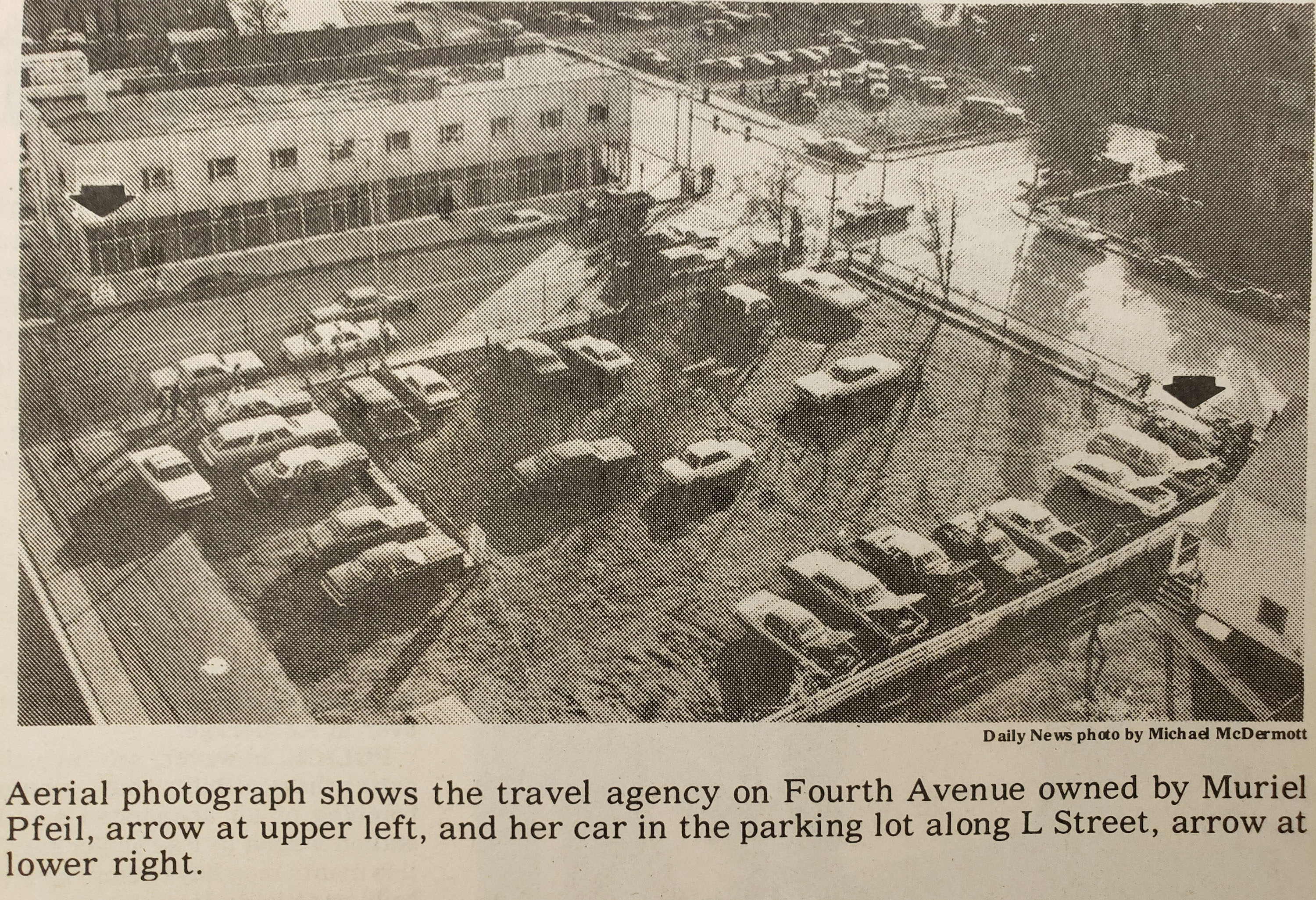
Volvo station wagon (arrow bottom right).
Photo: Michael McDermott. Copyright Anchorage Daily News
Less obvious is that, according to testimony from Muriel’s employees, her parking spot was not visible from their office, across the street. The only employee who “witnessed” the bombing was headed toward the bank to make a deposit. She heard the blast behind her and soon learned of the tragedy unfolding in that parking lot. Reliable reports also indicate that some of Muriel’s employees gravitated to the scene. One was seen to be overwhelmed with emotion…
That said, a lot has changed over these fifty years. Below is a more contemporary photo, taken by Loren Holmes of the Anchorage Daily News. Note that what was once a fairly drab office building is now dominated by the colorful (and wonderful) Snow City Cafe. It’s a bright spot in a once dark place.
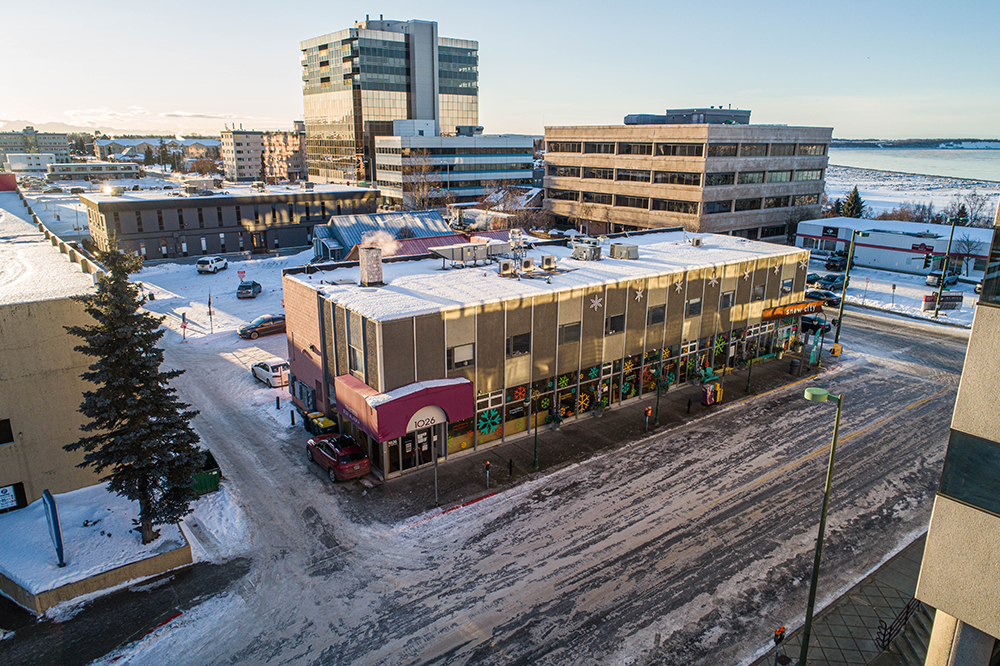
Photo: Loren Holmes. Copyright Anchorage Daily News
And Now… Introducing Doug Pope
Doug Pope is an “Alaskan’s Alaskan.” Born in Fairbanks before Statehood. A fisherman. A hunter. An outdoorsman. An author. He’s also an attorney who worked his way through law school. The hard way. That meant “commuting” between law school in Oregon — Willamette University to be exact — and summers in Fairbanks. In the heart of Alaska.
I had worked construction, putting my way through college. It took me ten years to get through college and law school. And I worked construction in Fairbanks, and one of the jobs I’d worked around was blasting riprap and rock. And so I knew the smell of high explosives.
Doug Pope, November 6, 2019
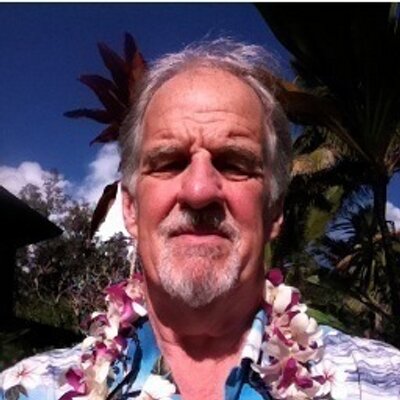
Somewhere in Hawaii.
There’s a lot more about Doug Pope here.
Witness to Murder
Attorneys sometimes work murder cases, representing either the State or the defendant. Attorneys sometimes commit murder. We’re all human. Doug Pope has the dubious distinction of witnessing a murder. The following quotes are taken from an interview Doug granted me in 2019, when I was at the very start of my Kill Brother, Kill Sister journey. I am forever grateful for his first-person account. There are, it turns out, some things we can never forget.
The Interview (Excerpts)
Doug Pope, November 9, 2019
POPE: [I was] sitting in a chair – a swivel chair – feet propped on the window sill or the radiator beneath the window sill. And I was on the phone… I heard this WHOOMPH more than a whoomp. I just kinda turned my gaze because my window overlooked the parking lot that Muriel Pfeil’s car was in. I saw the hood of the car going up like – when I was a kid we used to put firecrackers in a lead pipe and drop a can into them. And the firecracker would go off and shoot the can out. And it reminded me of that.
Here was this hood going up in the air, it must have gone five or six stories in the air, because I just kept watching it, and it was kind of slowly rotating and then it reached its peak and then it came down. And then I looked out — there was some — I can’t remember — there was a woman down at the car. People were there already. At least one. So I ran out to see what I could do. Or if there’s anything. And memory is a tricky thing… I’m pretty sure I got close enough to the car to look and see that whoever was inside was not sitting up.
HALE: When you say “not sitting up,” do you mean slumped?
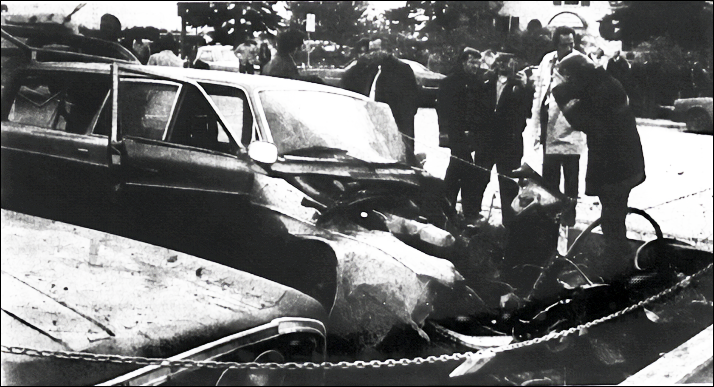
Copyright Anchorage Daily News
High Explosives
POPE: Yeah. Just a really really vague… Because I didn’t want to get close to it. Because I think there… it was possible there was a police officer there… already then… Because I remember… I think I went back inside. Because other people were showing up and I thought, Ok, I’m just going to stay out of this.
But I can remember smelling the high explosive. And I had worked construction, putting my way through college… I worked construction in Fairbanks. And one of the jobs was blasting riprap and rock. And so I knew the smell of high explosives. And I remember being down there… Maybe I left and came back… But there was a police officer there. And he was speculating, “Oh maybe the carburetor blew up,” or something. And I said, “Can’t you smell – and I may have used cordite – can’t you smell it?” I remember asking him that.
Bright Orange Volvo
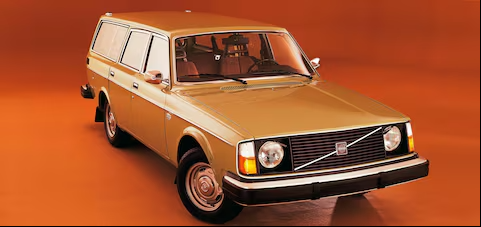
POPE: You know… what I learned later is that I was an early suspect because I said, “Can’t you smell it?” And that the cops were actually looking at me for a few days. (Laughs) But I do remember being out there looking and standing maybe 20 feet away from the driver’s side window. I had already seen the hood go in the air. And seeing that whoever was inside was not sitting up. They were either slumped over, laying over… I can conjecture now that maybe she was in pieces… But I didn’t think about that at the time… I just thought well there’s nobody alive in there. Or if they are…
NOTE: Muriel Pfeil’s body was intact, save for parts of her right hand, severed by the blast as she turned the key.
Doug Pope: A Suspect?
HALE: There’s a quote in the Anchorage Times – where you said something to the effect that, whoever did it must have had some expertise. Because of the way the blast went off.
POPE: Did I say that really? I was probably trying to aggrandize myself. Well, I knew enough about high explosives that you can direct a blast. But yeah… remembering back to what I saw at the time… But I remember at the time thinking, yeah, whoever did this knew what they were doing. And that was just because of my experience around high explosives. Because you know when you’re blasting rock, it’s a targeted explosion. And you’re not trying to blow up the entire hillside. What you’re trying to do is fracture it. And not be part of it.
So anyway… interesting. That quote is probably another reason that cops thought, oh, maybe it’s Pope… But anyway… But yeah, I’ll always remember that hood, you know… Until my dying breath I’ll remember it going up into the air, going “Oh my God.”
The Book: Kill Brother, Kill Sister
Kill Brother, Kill Sister is available at Amazon, Barnes & Noble and other fine bookstores (paperback and ebook).
Copyright Leland E. Hale (2026)