The race to retrieve Scotty Mackay was, in many respects, a shit-show from the very start. An effective one, yes, but one that landed as comedy, farce and, ultimately, tragedy. Consider this: by the time Steve Goodenow and Ramon Villagomez reached the Hon. Judge Robert Hefner’s High Court in Saipan — there to definitively authorize their recovery of Scotty — Neil Mackay was already back in Honolulu. In jail. He even sent Rodger Cotting a too cute telegram that read, “The President is coming.” Except, with warrants now in place, Scotty’s dad instead faced a bizarre cat-and-mouse take down at the Honolulu airport. He was neither heroic nor presidential.
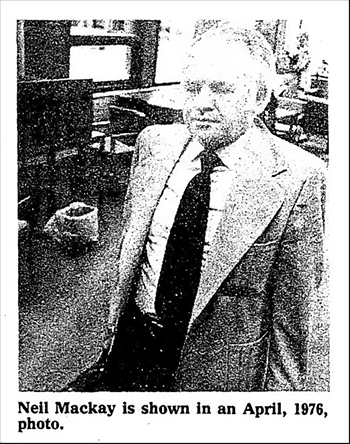
Held in the Halawa Jail, where he was a less than contrite prisoner, Neil Mackay brought no shortage of spectacle. In a March 16th appearance outside the Honolulu Family Court, he chided a reporter, apparently oblivious to the irony.
"Scotty has been tugged at, and tugged at, and tugged at. He’s been moved from place to place. I ask you, is this any way to treat a child? It’s shameful." Neil S. Mackay, Honolulu Family Court, March 16, 1978
Meanwhile…
Back in Majuro, however, it seemed that Mackay had never stopped pulling the strings. Consider this: Once the Cotting’s turned diffident about Scotty’s adoption, Neil looked elsewhere. Looked, in fact, to Charles “Chuck” Sullivan, he of the Charles and Jean Sullivan traveling peanut gallery. Chuck Sullivan would ultimately tell several Alaska Courts that “he felt like a grandfather to Scotty and was prepared to adopt him — at Neil Mackay’s request — in order to thwart Robert Pfeil’s efforts to adopt Scotty.” [State of Alaska vs. Neil S. Mackay, Court No. 3AN-S85-7630 Cr., August 7, 1987].
According to Chuck Sullivan’s in-court testimony, “In Micronesia, Neil and I spoke of me adopting Scotty. Neil spoke to a lawyer about it. He said the papers were made out. Neil did not say why he wanted me to adopt him,” then added, “Neil said, ‘then there would be no way that the Pfeil’s could get Scotty back.’ I don’t remember if I signed the papers… I thought I was going to have Scotty.”
Indeed, Charles Sullivan was in Majuro as the search for Scotty heated up. Was, in fact, spotted at the Cotting home, bad heart and all [1]. Spotted, that is, but careful not to be seen.
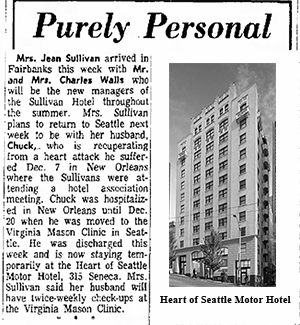
Fairbanks Daily News Miner, Feb 1, 1964
The Battle Shifts
The adoption tactic was soon dropped, however, perhaps because it had always been a ruse. In any event, it was now thought that Mackay and his cronies would fare better in the local Majuro court, presided over by a judge named Kabua Kabua. That’s not a typo. His first name was his last name. The judge was, in fact, from a prominent local family, blessed by a long line of Chamorro power and influence. Which, as it turned out, meant that the plaintiffs in this case — Steve Goodenow and Ramon Villagomez — were at a distinct disadvantage when they ventured into the courtroom. First was the sense of overarching resentment toward outsiders — U.S. outsiders — within the courtroom. Judge Kabua Kabua’s 17 March 1978 Protective Order made that explicit, noting:
...that courts of the United States have in the past failed to give full faith and credit to adoption and other orders of the courts of the Trust Territory, and that the court is therefore not obliged by any established reciprocity to observe application of a doctrine of comity with respect to any conflicting orders previously entered in jurisdictions or courts outside the Marshall Islands.
Parse This
There’s a lot to parse here, but it all boils down to a very simple message: The United States has treated us badly. They don’t respect our Court rulings. We feel no obligation to respect theirs. And, parenthetically: we soon hope to be free of you. Signed, Judge Kabua Kabua.
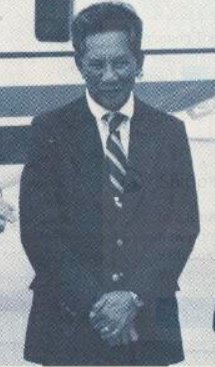
(1980, Courtesy Wikipedia)
Nor was that the only disadvantage facing Goodenow and Villagomez. Once in Judge Kabua Kabua’s courtroom — ostensibly to overturn the Protective Order — they learned something new. The hearing was to be conducted entirely in the local Marshallese language. The documents? Also filed in Marshallese. That put even Ramon Villagomez on notice, since he did not speak the language. To make matters worse the clerk translated the testimony at the least expansive level. Their only luck: Goodenow and Villagomez were seated near a local who confirmed that not all information was being translated — and helping to fill in some of the blanks.
The frustration was palpable. Goodenow and Villagomez felt the trial unnecessary. That it was, in fact, a stall. A stall that turned out to advantage no one but the Cotting’s and others involved in keeping Scotty away from anyone even slightly resembling U.S. authorities, whether Alaskan or Hawaiian. There were, of course, deep historical reasons for this attitude. Micronesia had long been the pawn of world powers, among them the Spaniards and Germans, followed by the Japanese and then, during World War II, the Americans. A change was in the air and Kabua Kabua was expressing it openly.
Missing the Missive
So, while some thought perhaps this trial in Judge Kabua Kabua’s courtroom was all for show… It was also a formality. One designed to place power relationships in their proper order. For his part Jim Winn, the district administrator, was adamant that going through Kabua Kabua’s court was the only course available. As Winn told Goodenow and Villagomez, “[I] have to live in the community.” That said, Villagomez went ahead despite the setback — drafting a motion setting aside the Cotting Guardianship and the Temporary Retraining Order. Those hasty orders had prohibited anyone — anyone — from removing Scotty from Majuro. That was only the least of their challenges.
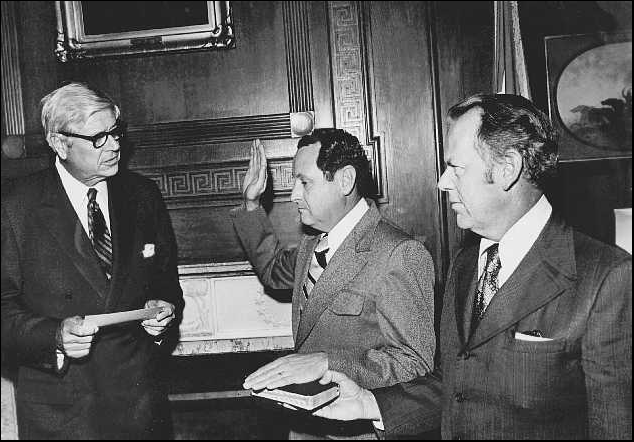
(Courtesy University of Hawaii/Manoa)
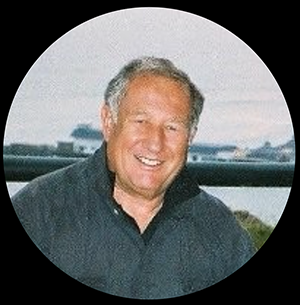
Before the hearing Villagomez had dutifully called the High Court Judge — Robert Hefner — in Saipan. Hefner unequivocally said that his High Court order took precedence over the Lower Court decision. Period. End of Subject. All the parties knew this. Knew before the hearing. That included one George Allen, who represented the Cotting’s in the custody matter — and was paid on Neil Mackay’s dime [2]. Can we add charade to our list and mix it with a little cynicism? [3]
(Courtesy LinkedIn)
[George] Allen [had] apparently decided to stall things out. It then
appeared to become a war of attrition: whether or not Villagomez and
Goodenow could hold out as long as Allen could stall things. Steve Goodenow, Memo To File, May 1, 1978
Every Story Needs A Villain
So there it was. The villain behind the scenes was — apparently — Mr. George Allen. His strings were being pulled by his benefactor. Who was miles away. In jail.
- When Sullivan subpoenaed for Neil Mackay’s 1986 Fairbanks murder trial, he was assured that, “Six internists and three cardiologists are certified to practice at the Fairbanks hospital.”
- George Allen did, in fact, have an impressive resume. Harvard Law, for one. Also: a successful Class Action suit on behalf of Marshall Islands landowners adversely affected by U.S. nuclear weapons testing (People of Bikini Atoll v. United States). He also assisted in a negotiated increase in landowner compensation for use of the Kwajalein Missile Range. That’s just the start of a mostly illustrious career.
- Steve Goodenow held a more jaundiced view of George Allen. In a letter to Lee Hoskins, who led the Micronesian version of the FBI, Goodenow noted that “Allen may be guilty of contempt when he a) failed to recognize the mandate from the High Court by instituting lower court proceeding and b) subverted the intent of the High Court by using his relationship with Judge Brown to have me detained in the Trust Territories.” Like Jim Winn, Allen also “had to live in the community.”
The Book: Kill Brother, Kill Sister
My latest book is available at Amazon, Barnes & Noble and other fine bookstores (paperback and ebook).
Copyright Leland E. Hale (2026)