December, 1977: Caught In A Trap?

Rodger Cotting was, by most measures, the perfect candidate for carrying out Scotty’s hasty “escape” from the authorities, both Alaskan and Hawaiian. A Navy “brat” who’d moved to Guam as a teenager, Cotting had spent almost 20 years in the Trust Territories.
He was, moreover, married to a local woman. Had four children with his wife, the former Marie Barcinas. They were active in the local Catholic church and, perhaps most important, Rodger Cotting held a crucial role with the local Marshall Islands government. It meant, more than anything, that he and Scotty were unlikely to get caught up in the red-tape that could thwart Scotty’s entry into Majuro, their ultimate destination.
Part of that was due to Scotty’s “new name.” He was now “John Cotting,” Rodger Cotting’s “son.” Because, in those days — the late-70s — flight rules were a lot less restrictive. Security was, in some ways, an informal contract. For example, Scotty did not need a birth certificate to enter the country, only when he left. Tricky, especially since they were already in violation of the Uniform Child Custody Jurisdiction Act. But, hey, this was an “emergency.”
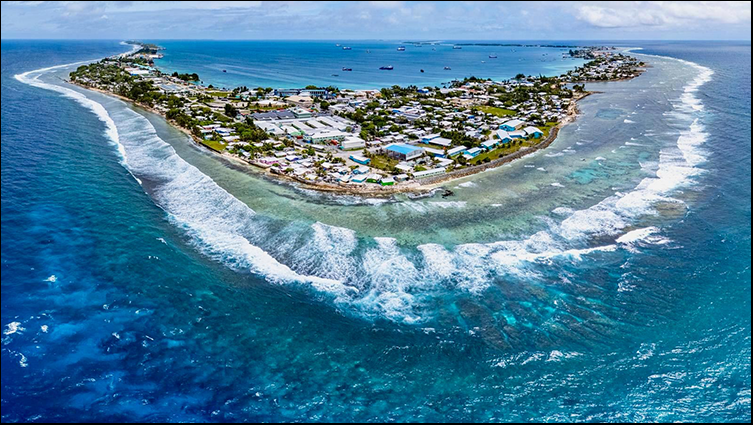
Majuro Here We Come
A skinny sliver of coral and rock, Majuro is 2273 air-miles from Honolulu if, that is, a direct flight were available. Which it wasn’t. Not then. Not now. That doesn’t mean Majuro was less than important. It was. It is. Standing at the center of the universe for that sprawling corner of the former Trust Territories known as the Marshall Islands, all the administrative offices are there, on that slender Atoll. The officials who “run” the place, the courts, the administrators, the police — they’re all there, the whole lot of them. Because at the time, the Marshalls were still governed as a U.S. Trust Territory; many of the top officials were Americans. And, despite the challenging setting, they’d somehow managed to sneak in a slender landing strip, courtesy of the Japanese military (and others, including the U.S. military). The import of that? Access was, indeed, guaranteed. [1]

Logistically speaking, moreover, the entire universe that was once called the “Trust Territories” — now known as the Federated States of Micronesia — actually “starts” in Guam, which is itself part of an entirely different entity called the Northern Mariana Islands. Confused yet? Blame that on World War II, which unstintingly scrambled this region in the interests of various world powers. Suffice it to say that Guam is a vital hub in the North Pacific and most flights to Micronesia historically originate there.
Getting There
And so it was that “John Cotting” and his “guardian” left Honolulu on a mind-sapping journey. They were embarked on what’s lovingly called the “Island Hopper.” FOR SIXTEEN HOURS. First Stop: Guam: 3,800 miles from Honolulu; 8 hours. Second Stop: Chuuk, Micronesia: 632 miles from Guam; 1 hr, 45 minutes. Third Stop: Pohnpei, Micronesia: 438 miles; 1 hr, 15 minutes. Fourth Stop: Kwajalein, Micronesia: 662 miles, 1 hr, 45 minutes. Fifth Stop: Majuro, Marshall Islands: 269 miles, 1 hr. Oh, and all of the landings are on… short runways. Hold. Your. Breath. Pray. They. Stop.
Yes, But Can You Sleep?
With a sixteen hour journey on the menu, the needs of the human body tend to loom large. The elusive notion of sleep is best left to that first flight, the one between Hawaii and Guam. It’s one long, uninterrupted segment, with eight hours of… relative peace. Of course, if you’ve ever traveled with a child, you know a lot can go wrong. Even without the child. Who hasn’t heard the screaming baby at the back of the plane? The one whose mother is — in this case — wishing she’d taken the boat?
Anyone who’s ever taken intercontinental flights also knows the challenges of “comfort.” The tin-can analogy is apt, especially when you remember the narrow body jets prevalent throughout the 70s (and beyond). In case you never knew — or have forgotten — here’s a reminder:

Where’s Scotty?
One would also surmise that, given the length of the flight, someone — or even multiple someones — could have seen Scotty onboard the plane. Seen him and identified him. Indeed, in the days and weeks after Scotty’s infamous Pacific Ocean adventure, various police or police-adjacent entities tried to trace his journey. Law enforcement agencies already had a description of their “subject.” It was, in fact, a widely circulated description:
SEARCH WARRANT
SCOTTY P. MACKAY aka JOHN S. COTTING. Sex: Male. Color of Hair: Brown. Color of Eyes: Bizarre. Age: Five.
A World of Difference(s)
A search warrant and a subject description are one thing. What Neil S. Mackay was attempting was the old “needle in a haystack” trick. First up, put two thousand more miles between Scotty and Alaska. Second, take him somewhere with more open ocean than land, where even the birds couldn’t find him. But, honestly, the search warrant itself was… Flawed.
Color of Eyes
Did you catch that? “Color of Eyes: Bizarre?” There’s an eye-color called Bizarre? Really? Actually, yes — “bizarre” is a legitimate eye color description. Have you heard of it? Can you tell me — without looking it up — what the hell that looks like?
Let’s start at the top: there are three distinct categories of eye color among humans. (1) Common eye colors are determined by the amount and distribution of pigment, which result in three dominant eye colors: Brown, Blue and Gray. These are, as the name implies, the most usual eye colors. (2) Eccentric eye colors are less common, but still within the usual range of human eye colors. These eyes are Green (comprising only 2% of eye colors); Amber (either solid gold or copper); or Hazel, which are a mix of brown, green and gold.
Bizarre eye colors, on the other hand, are caused by a rare genetic condition called heterochromia; less than 1% of people have this trait. Examples include conditions where each eye is an entirely different color, e.g., one brown, one blue. Or where spots of color are found in one iris, like splatters of paint scattered about. Or even where the color around the pupil is different from that of the surrounding iris. Which, if you boil it down, puts Scotty in a unique group. And me? Still confused.

OK, What About His Hair?
The other thing worth noting is Scotty’s alleged hair color. Eyewitness accounts describe his hair color as… Let’s just say, not brown.
So when a Private Investigator assigned to recover Scotty asks if possible witnesses have seen the boy, he describes him as a “small, blonde boy of about five (years old).” When another possible witness reports seeing a fire year old child on a recent flight to Saipan, she notes that he had a name-tag reading, “Hi! My name is Scotty.” She continues, in her affidavit, to describe him as a “small boy about 5 years old who had blond hair and blue eyes,” later changing that to “blondish.”
So, it’s a problem, isn’t it? You want witnesses to go from the Subject Description line and say, “hey, that’s him!” Because… Every transit point has the potential for a match and a catch. Someone has seen him. Remember, there are at least five transit points. But then there’s also this…

He’s A “Well-Behaved” Child
What’s really worth noting here, in fact, are the seeming lack of incidents involving Rodger Cotting and Scotty Mackay. Let’s be clear: On a journey like this, the last thing a guardian wants — especially one featuring a tenuous, temporary relationship with the child in question — is an inconsolable kid who’s alternately restless and unhappy. One who cries, fights… and draws unwanted attention to himself. Scotty was — in all likelihood — none of the above.
No, in some ways he had been “trained” for this journey, in the proximate instance by traveling nonstop to Hawaii with his father. Perhaps more important, in Alaska he’d been arbitrarily moved from household to household — multiple times — in the two or so years since his mother’s 1976 murder. Taken first by his maternal uncle, who literally picked him up at his daycare facility on the day of his mother’s murder. Then moved BY THE COURT to the home of an Alaska Supreme Court justice. Subsequently bounced to his maternal aunt, his dad and then back to his maternal aunt. It’s exhausting just to type that.
No surprise: Scotty’s bag was always packed, ready for the next (arbitrary) move. A psychiatrist, hired by the Alaska courts to examine him, brought keen insights into Scotty’s state of mind.
Dr. Norman N. Janzer, a Seattle physician who specialized in psychiatry, had seen both Scotty and his father. “Scotty has more than seven parent figures in his life right now,” Janzer told the Alaska court during one of his penultimate custody hearings. “That’s too much for a child.”
The Book: Kill Brother, Kill Sister
My latest book is available at Amazon, Barnes & Noble and other fine bookstores (paperback and ebook).
Copyright Leland E. Hale (2026)